We use the word Interval to measure the distance between notes, the same way you’d use a ruler to measure how far two objects are apart.
As you might remember, the white keys on a piano are named after the musical alphabet: A, B, C, D, E, F, and G. If you look closely at the keyboard, you’ll see black keys tucked between most of the white keys.
A Half Step is the shortest distance between any two notes on the piano that are right next to each other, with no keys in between. Going from a white key to the black key touching it is a half step.
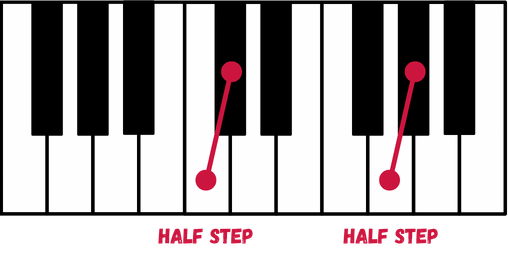
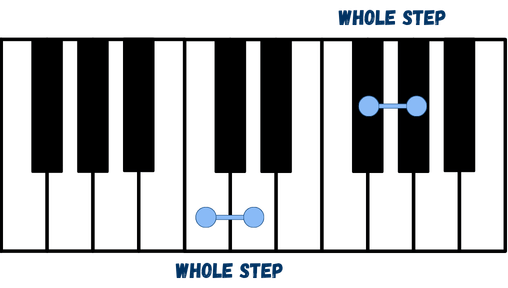
A Whole Step equals two half steps put together. Follow along: 1st half step from the white key up to the black key. 2nd half step — from that black key up to the next white key. The distance between those two white keys is a whole step!
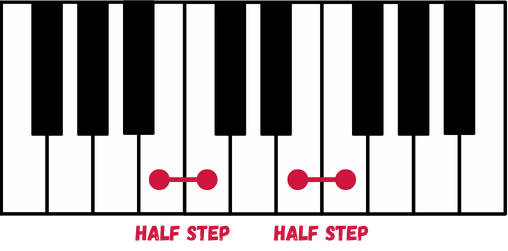
The secret exception: look really closely at the keyboard. Did you notice there are two spots where two white keys are touching with no black key between them? Is the distance between those two white keys a whole step or a half step?
Answer: it’s a half step! Why? Because the keys are right next to each other with nothing in between.
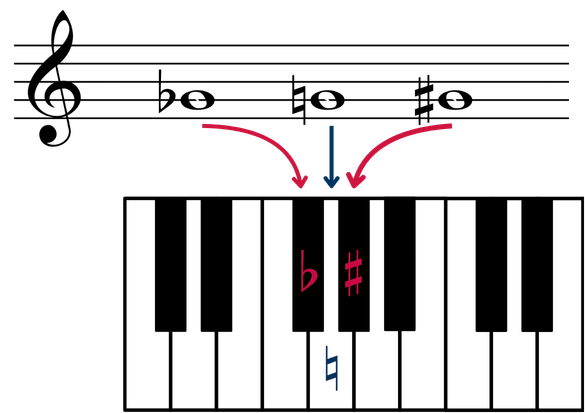
If we have names for those white keys (musical alphabet), then what do we call the black keys? We use Accidentals to shift pitches up or down by a half step.
The word Sharp (written like #) raises a pitch by a half step. The word Flat (written like ♭) lowers a pitch by a half step. The “regular” version of a note is called Natural (written like ♮).
If we started at G, saying G# (pronounced G-sharp) gets us to the black key on the right, while saying G♭ (pronounced G-flat) gets us to the black key on the left. The G# sounds higher than a G, while the G♭ sounds lower.