Music is the art of organizing sound and silence.
It’s easy to think of music as being organized on a grid. Sounds can be high or low (pitch) and exist on a timeline (rhythm). Musicians use a special grid called a Staff. A staff has five lines (and four spaces) and is read both up and down and left to right.

Pitch tells us how high or low a sound is.
A Note is a symbol that represents a pitch. Higher notes are drawn closer to the top of a staff, while lower notes are drawn closer to the bottom of a staff.
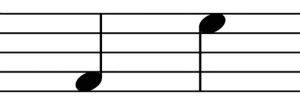
If we run out of room, we can even draw extra, shorter lines (called Ledger Lines).

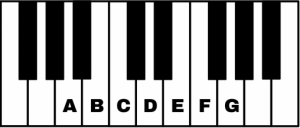
Just like you, each note has a name. To make it easy to learn, we use a Musical Alphabet, which is the first seven letters of the alphabet you already know: A, B, C, D, E, F, G. As we go forward in the alphabet, notes get higher, and as we go backwards in the alphabet, notes get lower. Once we run out of letters, we just start back over so we can go as high or low as we want!
A · B · C · D · E · F · G · A · B · C · D
If you walk up to a piano or keyboard, the white keys correspond to the notes of the musical alphabet. As we go to the right on a piano, the notes get higher and the musical alphabet moves forward. As we go to the left on a piano, the notes get lower and the musical alphabet moves backwards.